


Introduction
A femur fracture is a serious injury involving a break in the thigh bone, the longest and strongest bone in the human body. Because of the femur’s critical role in supporting body weight and movement, most fractures require surgical treatment to restore alignment and promote healing.
Two of the most common surgical methods are intramedullary rods (nails) and bone plates with screws. While both techniques are effective, the choice depends on the type and location of the fracture, the patient’s overall health, and the surgeon’s assessment.
Understanding Femur Fractures
Femur fractures can result from:
- Road traffic accidents
- Falls from height
- Sports injuries
- Osteoporosis-related trauma in older adults
- High-impact injuries
The location and pattern of the fracture often determine the most suitable fixation method.
What Are Intramedullary Rods?
An intramedullary rod, also called an intramedullary nail, is a metal rod inserted into the hollow center of the femur. The rod is secured with locking screws above and below the fracture.
Advantages of Rods
- Strong internal support
- Allows early weight-bearing in many cases
- Smaller surgical exposure
- Preserves surrounding soft tissues
- Effective for fractures occurring in the shaft of the femur
- Lower risk of disrupting blood supply around the fracture
Potential Disadvantages
- Possible pain around the hip or knee where the rod is inserted
- Technical challenges in certain fracture patterns
- Rare complications such as hardware failure or malalignment
What Are Plates and Screws?
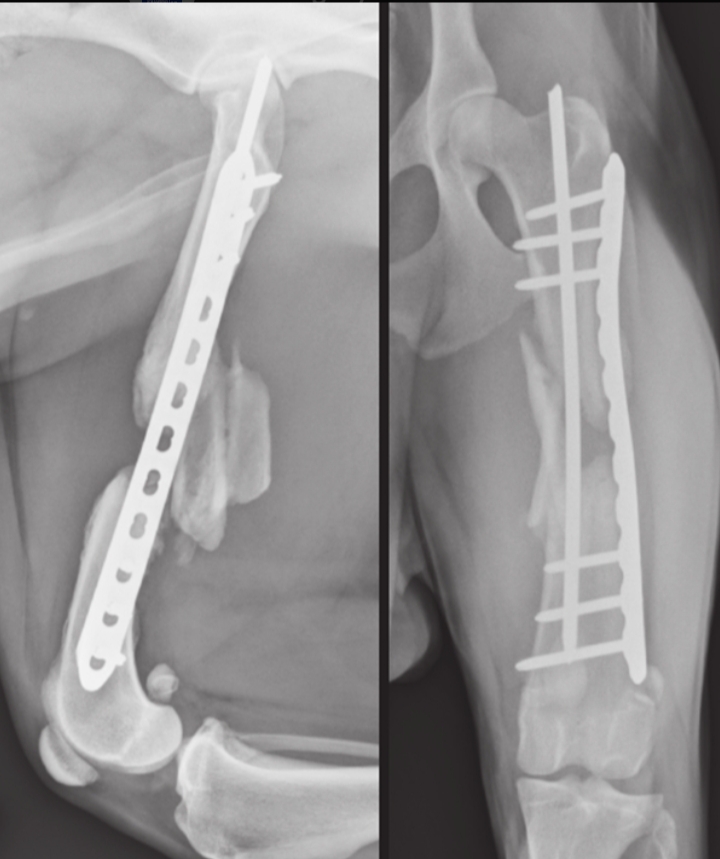
Plate fixation involves attaching a metal plate along the outer surface of the femur using screws to stabilize the broken bone.
Advantages of Plates
- Excellent control of complex fracture alignment
- Useful near joints where rod placement may be difficult
- Effective for fractures involving the upper or lower ends of the femur
- Allows precise reconstruction of fragmented fractures
Potential Disadvantages
- Larger surgical incision
- Greater disruption of surrounding soft tissues
- Potentially longer healing time in some cases
- Higher risk of infection due to larger surgical exposure
When Are Rods Preferred?
Intramedullary rods are often considered the standard treatment for fractures occurring in the middle portion (shaft) of the femur.
They are commonly chosen because they:
- Share load efficiently with the bone
- Allow earlier mobilization
- Require less extensive surgical exposure
- Provide excellent long-term stability
For many adult femoral shaft fractures, rod fixation remains the preferred approach.
When Are Plates Preferred?
Plates may be recommended when:
- The fracture extends into a joint
- The fracture is very close to the hip or knee
- The bone anatomy prevents rod placement
- Multiple fracture fragments require precise reconstruction
- Previous implants make rod insertion difficult
In these situations, plating can provide better control of fracture alignment.
Recovery and Rehabilitation
Recovery depends on:
- Fracture severity
- Patient age
- Overall health
- Surgical technique
- Rehabilitation participation
Most patients undergo:
- Physical therapy
- Gradual weight-bearing progression
- Strengthening exercises
- Mobility training
Complete healing may take several months, although many patients begin rehabilitation shortly after surgery.
Which Option Is Better?
There is no single best option for every femur fracture.
In general:
- Intramedullary rods are often favored for femoral shaft fractures because they provide strong support with less disruption to surrounding tissues.
- Plates and screws may be more suitable for fractures near joints or highly complex fracture patterns requiring precise anatomical reconstruction.
The ideal treatment is determined by the specific characteristics of the fracture and the patient’s individual needs.
Conclusion
Both rods and plates are proven methods for treating femur fractures. Intramedullary rods are commonly used for fractures in the middle of the femur, while plates are often chosen for fractures near the hip or knee or for more complex injuries.
A thorough evaluation by an orthopedic surgeon helps determine the most appropriate treatment strategy, ensuring the best chance for successful healing, restored function, and a return to daily activities.