


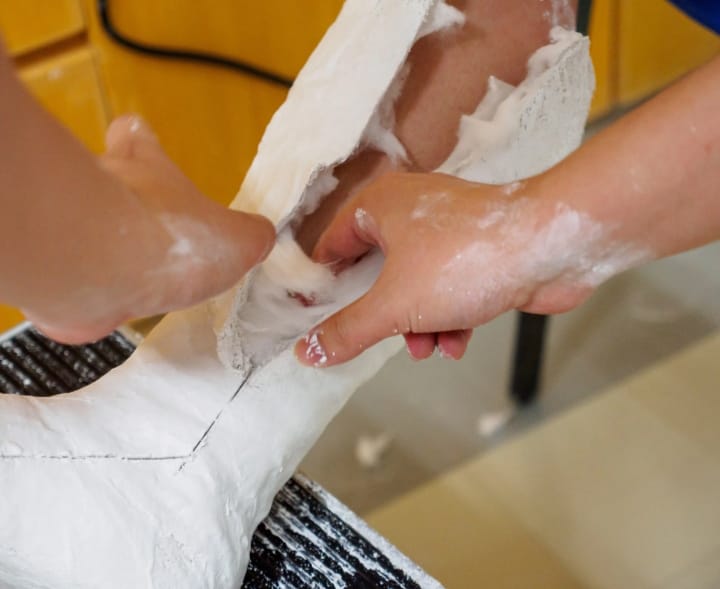
When a bone breaks, one of the most common treatments is immobilization with a cast. Patients often wonder why the cast is typically removed after roughly six weeks. The explanation lies in the body’s natural healing system known as bone remodeling, a carefully coordinated process that restores strength and structure to injured bone.
What Happens After a Bone Breaks?
Bones are living tissues, not dead structures. They contain cells, blood supply, and minerals that allow them to heal when damaged. Once a fracture occurs, the body immediately begins repairing itself in a series of stages.
Two key cells drive this process:
- Osteoclasts, which remove damaged bone
- Osteoblasts, which build new bone tissue
Together, they rebuild the bone from the inside out.
Stage 1: Initial Response and Clotting (First Few Days)
Immediately after a fracture, the body forms a blood clot around the injury site. This clot helps protect the area and acts as a foundation for new tissue growth.
Inflammation also begins, bringing essential healing cells and nutrients to the damaged bone.
Stage 2: Soft Callus Formation (1–3 Weeks)
Within the first few weeks, the body begins forming a soft bridge made of collagen and cartilage called a soft callus.
At this point:
- The bone is still fragile
- Movement must be avoided
- A cast is needed to keep everything stable
Stage 3: Hard Callus Formation (Around 3–6 Weeks)
This stage explains why casts are often removed after about six weeks.
The soft callus gradually hardens as minerals such as calcium are deposited, forming a hard callus. This creates a stronger connection between the broken bone ends.
By this stage:
- The bone is stable enough for basic support
- Pain has usually reduced significantly
- The main structure of healing is in place
Stage 4: Bone Remodeling (Weeks to Months Later)
Even after the cast is removed, healing continues. The bone slowly reshapes and strengthens itself over time.
During remodeling:
- Excess bone tissue is broken down
- The structure is refined for efficiency
- The bone gradually regains full strength
Why Six Weeks Is the Usual Timeline
The six-week period is a general estimate based on how long it typically takes a hard callus to form in uncomplicated fractures in healthy adults.
However, healing time can vary depending on:
- Age (younger individuals heal faster)
- Type and severity of the fracture
- Location of the bone
- Overall health and nutrition
- Blood supply to the injured area
So, while six weeks is common, it is not a fixed rule for every case.
The Importance of a Cast
A cast plays a critical role in recovery by:
- Keeping bone fragments aligned
- Preventing movement that could delay healing
- Creating a stable environment for new bone growth
Without proper immobilization, the bone may heal incorrectly.
Conclusion
Bone healing is a complex but efficient natural process that gradually restores strength after injury. The typical six-week casting period corresponds to the time needed for a stable hard callus to form, allowing safe removal of the cast in many cases.
Even after removal, the bone continues to remodel and strengthen for months, showing that recovery is a gradual process that extends well beyond the initial healing phase.