


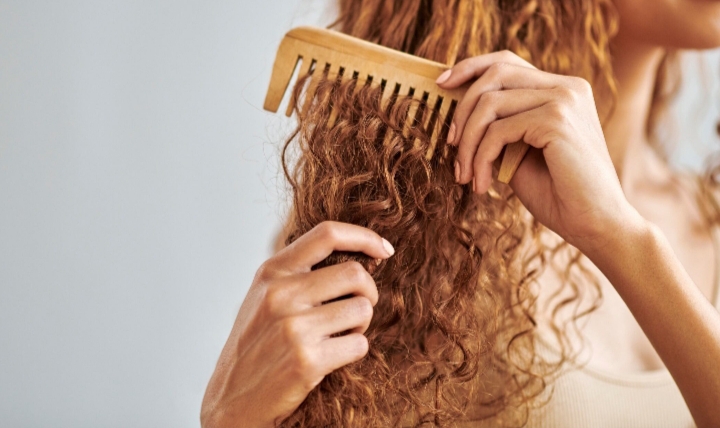
Curly hair is naturally distinctive and expressive, but it behaves quite differently from straight hair. Because of its unique structure and biological characteristics, curly hair often needs a different approach to care. By understanding the science behind curly hair how it grows, how it holds moisture, and how it reacts to the environment it becomes easier to see why specialized routines and products are often recommended.
Hair Shape Begins at the Follicle
1.The pattern of a person’s hair is largely determined by the shape of the hair follicle in the scalp.
2.Straight hair usually grows from round follicles.
3.Wavy hair forms from slightly oval follicles.
4.Curly or coily hair develops from flattened or elliptical follicles.
Because curly follicles are not symmetrical, the hair strand grows in a curved or spiral form. The angle at which the hair emerges from the scalp also contributes to the curl pattern.
Curly Hair Tends to Be Drier
Dryness is one of the most common challenges associated with curly hair.
The scalp produces a natural oil known as sebum, which helps moisturize the hair. In straight hair, this oil moves easily from the roots to the ends. However, in curly hair, the twists and bends slow down the movement of oil along the strand.
As a result, the scalp may feel oily while the middle and ends of the hair remain dry. This is why curly hair usually benefits from extra hydration and conditioning.
The Cuticle Layer Is More Exposed
Each hair strand is protected by an outer layer called the cuticle, which consists of overlapping scales. In curly hair, these scales are often slightly lifted or less tightly packed compared to straight hair.
This makes curly hair more susceptible to losing moisture and absorbing humidity from the environment. The result is often frizz, dryness, or loss of curl definition, especially in humid conditions.
Curly Hair Is More Prone to Breakage
Despite appearing thick and full, individual strands of curly hair are often more delicate. The bends and curves along the hair fiber create points that are more vulnerable to stress.
These weak points make curly hair more likely to experience:
Breakage
Split ends
Damage from excessive brushing or heat styling
For this reason, gentle handling, minimal heat, and protective styling methods are commonly recommended.
Understanding Hair Shrinkage
Another characteristic of curly hair is shrinkage, where the hair appears much shorter than it actually is.
For instance, a strand that measures 20 centimeters when stretched might look only half that length when in its natural curl pattern. This happens because the spiral shape compresses the strand. Although shrinkage can sometimes be frustrating, it is often a sign that the hair retains good elasticity and health.
Product Needs Are Different
Curly hair generally responds best to products that support moisture retention and reduce friction. These often include:
Leave-in conditioners
Curl creams
Lightweight oils
Gentle, sulfate-free shampoos
Products made for straight hair may remove too much moisture or weigh curls down, making them less defined.
Hydrogen Bonds and Curl Behavior
The shape and flexibility of hair are also influenced by hydrogen bonds within the hair’s keratin structure. These bonds temporarily change when the hair is wet.
This explains why hair can be styled more easily when damp, why humidity can cause frizz, and why heat tools can temporarily alter the curl pattern. However, frequent heat styling can weaken the hair structure over time.
Why Curly Hair Care Routines Are Unique
Because of these structural and chemical differences, curly hair care routines often focus on maintaining moisture and reducing damage. Common practices include:
1.Regular deep conditioning
2.Gentle detangling methods
3.Protective hairstyles
4.Mild cleansing to preserve natural oils
Styles such as wash and go looks, twist-outs, and braid-outs are often used to enhance curl definition while protecting the hair.
Conclusion
Curly hair’s structure, growth pattern, and moisture dynamics make it quite different from straight hair. These differences explain why curly hair can be more prone to dryness, frizz, and breakage. However, with the right care practices and products, curls can remain healthy, resilient, and beautifully defined.
Ultimately, curly hair does not necessarily need more attention than other hair types it simply benefits from care that suits its unique structure.